
During the early years of the 19th century, an ever increasing number of shipwrecks on the UK coast plus losses overseas of valuable ships, their cargo and their crews was having a serious impact upon the nations economy. Consequently the government authorised the formation of a “Shipwreck Select Committee” in Westminster which in 1836 recommended to parliament that the losses could be reduced by the education of seafarers and their certification.
Implementation was slow and it was not until 1844 that boys aged between 11 and 12 could be indentured to British shipping companies for periods of up to 7 years or until they were 21. In 1851 it became compulsory for the Masters and Mates of foreign going vessels to earn certificates of competency before taking command or standing a watch. Similar rules were also introduced for Home Trade officers in 1854.
The advantages of these changes were not lost upon ship owners, the new regulations ensuring the safety of their investment in ships and cargo as well as reducing their insurance premiums. Some form of pre-sea training was considered essential, so London based shipowners agreed to fund the foundation of the Thames Nautical Training College in 1862, to provide the required training for boys prior to going to sea.
The Admiralty was approached for the loan of a suitable ship for this purpose. The Royal Navy at the time was starting to replace their fleet of wooden walls with iron clad vessels. They had a large surplus of these older vessels laid up in the Nore anchorage along the north Kent shore of the Thames. The Admiralty responded by allocating the 1473 ton “two decker” HMS Worcester, whose keel had been laid in 1820 but as was typical for the period, had not been launched until 1843.
She was the sixth Royal Navy ship to bear the name Worcester but the first to become a training ship, and had been built at the Royal Naval dockyard founded by Henry V111 in Deptford in the early part of the sixteenth century. The ship was handed over the Nautical College in 1862, following the handover nearly £1000 was spent on her conversion into a training ship. Her first berth was on Blackwall Reach but within the year she had been moved to Erith, and then in 1869 to Southend.
This was an uncomfortable berth, the rolling causing seasickness and was not conducive to study. So in 1871 she moved to what was to become the final home of all later Worcesters, moored off the village of Greenhithe on the north Kent shore.
Starting with an initial entry of just 18 cadets, numbers soon increased, so that by the mid-1870s the first ‘Worcester‘ had become too small for the task and the Admiralty was approached for the loan of a larger vessel.

Worcester 1
In 1876 the committee was offered the two-decked battleship ‘Frederick William‘. She was an unusual vessel in many respects; her tonnage of 4,725 and length of 214 feet [65.23m] made her very much larger than even the preserved ‘Victory’. Her keel was laid in 1833 in Portsmouth as a 110-gun three-decker named the ‘Royal Sovereign’. Wooden ship construction was a lengthy process, but whilst still on the stocks the design was changed in 1859 to a two-decker to carry 116 guns. Further changes came before completion in 1860 – engines and boilers were installed and her armament was reduced to 86 guns. Another name change to ‘Frederick William’, as a compliment to the King of Prussia, she was launched 27 years after her keel was laid !
Those who have visited Portsmouth Dockyard in recent years will have seen the stunningly restored ‘HMS Warrior’ – one of the world’s first iron clad battleships. She was launched within a few months of the ‘Frederick William‘, whose design then became obsolete so it is not surprising that immediately upon launching she was ‘paid off’ into the reserve fleet at Portsmouth. She briefly spent two years as an Irish coastguard vessel but in 1868 she was laid up indefinitely in Portsmouth, with her machinery removed and was earmarked for service as a hulk.
In 1877 the ‘Frederick William‘ changed her name for a fourth time, to become the second ‘Worcester‘ and was moved to Greenhithe where she could comfortably accommodate over 150 cadets, though at one time it had been suggested 250 was a suitable figure!

Worcester II
The new ship saw a steady, though not dramatic increase in the number of cadets joining the ship. This carried on into the new century and the years leading up to the first world war.
The college realised that with the‘Worcester’ moored off Greenhithe that a shore base was needed. So in 1920 the Ingress Abbey on the adjacent shore was purchased together with its extensive grounds. These provided space for playing fields, offices, a sanatorium, laundry and a swimming pool. The shore base also enabled the ship to be connected to the shore, for power and water supplies.

During the war years, the staff and cadets were evacuated to nearby Foots Cray Place. The ‘Worcester’ was used as a training base by the Royal Navy. Inevitably a shortage of men and materials meant both ships lacked maintenance and deteriorated badly so by 1945 Worcester was in a very poor condition, she had lost most of her masts and was only kept afloat by a large salvage pump.

Cutty Sark arrives at her mooring off Greenhithe
The Worcester was a public school and the fees for each cadet were paid by a bursary, a scholarship or by the boys parents. These monies alone were not sufficient to maintain the high standard of training expected by the Board of Trade or the Shipping Companies with whom the fully trained cadets sought employment.
Nor could the income cover the huge cost of maintaining the ships or the other expenses of the college. However some of the wealthier shipping companies contributed in various ways to the running of the college, providing additional facilities and equipment for use by the cadets during their training.
Happily, a replacement for the ‘Frederick William’ was found in the form of the ‘Exmouth’, but after her war service, largely spent at Scapa Flow, she clearly needed all the financial resources and manpower the College could muster to recommission her as a replacement ‘Worcester’. She arrived in January 1946, greeted by Cutty Sark which was dressed overall.

Worcester III is moored at Greenhithe January 1946
At over 300′ long, the ‘Exmouth’ was an unusual vessel, since she was built in 1904 of steel and iron especially for nautical training and had many improvements over the converted hulks previously used. With good headroom, proper classrooms, heating, lighting and staff accommodation she certainly lacked the elegance of her predecessor, but was far more suitable for the purpose. Built by the London County Council to give sea training to boys largely from orphanages, she had been designed to accommodate 750. The Royal Navy had berthed as many as 600 ratings aboard during the war years – so there was room to spare for the 200+ ‘Worcester’ cadets.
Sadly, the final fate of the former ‘Frederick William’ was not a happy one – in accordance with the terms of the original loan, in 1945 she was returned to the Admiralty who were busy running down the vastly expanded war-time Navy. She was moved to Thurrock prior to being broken-up, but cheated the ship breakers by sinking at her moorings a few weeks later after breaking her back.
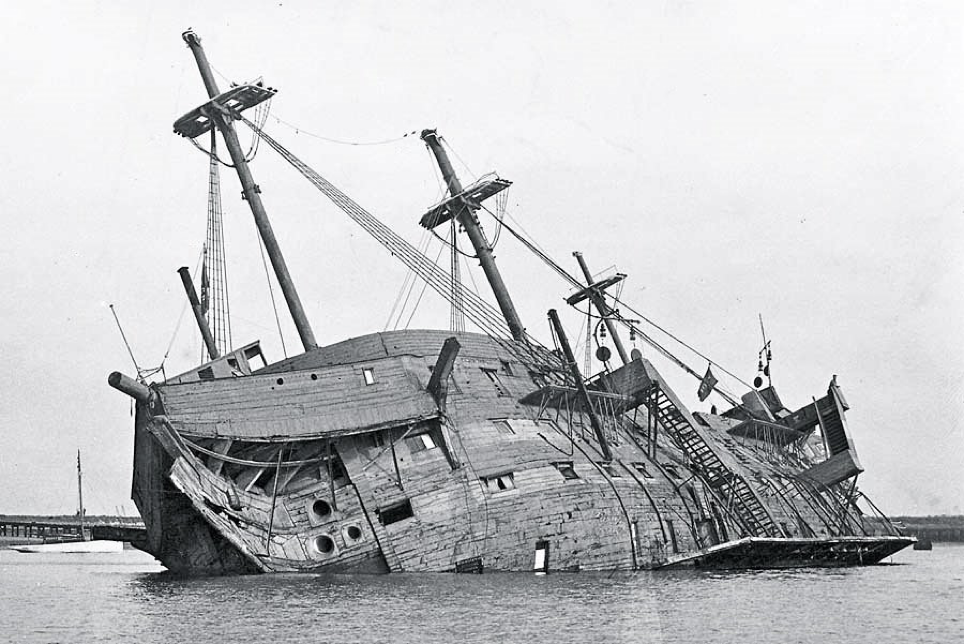
Worcester II aground, with her back broken at Thurrock
The arrival of Worcester III a purpose built training ship, meant the potential role of the Cutty Sark diminished. So with the approval of the original donor, Mrs Dowman, she was given to the nation through the National Maritime Museum. After restoration, she was moved to a permanent dry-dock at Greenwich where she remains to this day visited by many thousands every year.
The routine for the cadets onboard continued as before, accompanied by occasional changes in the nautical and academic staff. As with the previous ‘Worcesters’, cadets stayed aboard for just over two years, slept in hammocks and kept their belongings in a sea chest. Most left at about 16½ to join the various shipping companies – within a few months many had visited the farthest parts of the world and regularly returned to visit their Old Ship with tales of their adventures.
During the summer holidays in 1958 the hammocks were withdrawn and replaced by steel frame bunks hung from newly installed stanchions on both Lower and Orlop decks. The old hands were convinced that the replacements were nowhere near as comfortable and mourned the loss of their hammocks, which they rigged to suit their own personal preferences.
Life aboard continued accompanied by occasional changes in the nautical and academic staff. Some of the ships boats were changed perhaps the motor boats were the most noticeable. An RN motor cutter with its Kitchener gear propulsion and steering system was the one most enjoyed by the coxswains due to its flexibility. However for the reasons already mention with the decline of the British Merchant Navy the number of vacancies for boys wanting to go to sea as deck officers in British shipping companies declined steadily to a point where the college was no longer viable
There was a significant demand for cadets and deck officers throughout the late 40s and 50s, to replace the losses of the war years. The situation started to alter during the early 1960s which saw many changes in the world of shipping and with it a dramatic fall in numbers at sea – particularly under the British flag. This decline of the British Merchant Navy meant the number of vacancies for boys wanting to go to sea as deck officers in British shipping companies reduced steadily to a point where the college was no longer viable.
The College closed in 1968, those cadets who had not completed their training transferred to the Merchant Navy College which ILEA established ashore on the site also used by the Worcester. This College offered courses for Marine Engineers, Electricians and Radio Operators in addition to Mid Apprenticeship Release courses for deck apprentices. The idea of these MAR courses was that young men would sign their apprenticeships with a company and then partway through return to college to cover the theoretical aspects of their training.
Many of the 8,000 odd ‘Worcester’ cadets had long careers served with distinction at sea and under many flags. The Japanese Admiral Togo became one of his country’s great nautical heroes and H.R.Bowers sadly died with Captain Scott’s South Pole expedition in 1912. There were two other OWs on this expedition and, as a lasting memorial to them all, every modern atlas shows the range of ‘Worcester’ mountains they named. Lord Mountevans of the Broke was probably one of the most decorated officers of the Royal Navy in the First World War.
The majority of OWs went to sea in the Merchant Service and many went on to achieve high rank with the leading shipping companies – for example, in 1998 all four liners operated by the P&O Company were commanded by OWs! Sadly, the decline of the British merchant fleet post-war meant that many had to seek alternative employment ashore; some within the shipping industry but happily others have distinguished themselves in other fields such as the law, commerce, computers, engineering, surveying, publishing, travel, and the arts.
When the college closed in 1968 the spirit and loyalty that it had engendered did not die. The Association of Old Worcesters (AOW) founded in the early years lived on.There were no more rugby games between cadets and old boys but annual dinners in London and else where continued until the ever increasing pressures at sea limited this to the retired members before they gradually petered out.
Times change but the Association became more active in other ways. In Australia which is home to the greatest overseas collection of OW’s the started to join up with members of the other colleges, Conway Pangbourne and General Botha. Sydney, Queensland and Melbourne are still strong groups.
The last ‘Worcester’ was sold for scrap in 1978, she left her mooring off Greenhithe and towed down stream past Gravesend, across the channel to Bruge by the tug TEMI IV. There the works to dismantle and cut her up began.
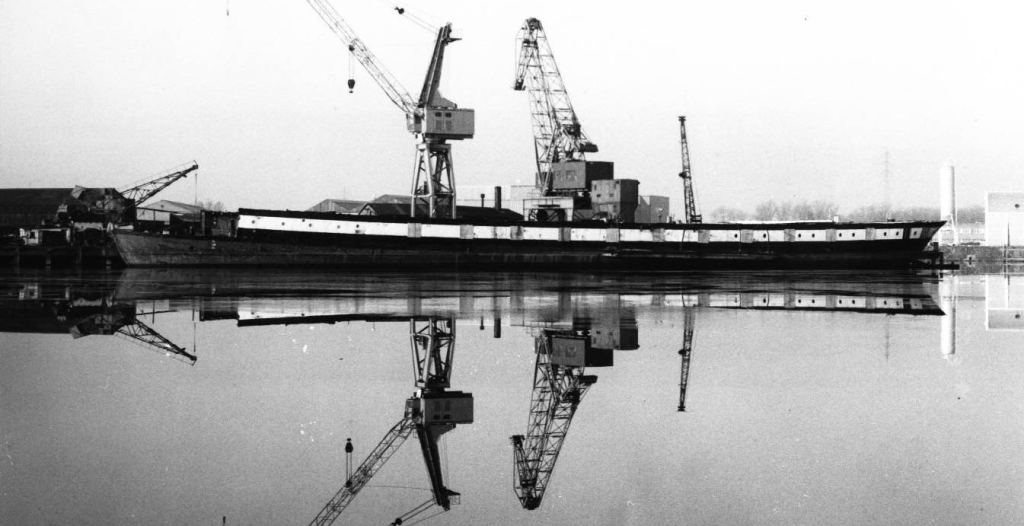
So ended a fine Merchant Navy College, a proud tradition and the end of an era ……………………
……………….. But this is not the end of the story as a new, bright chapter has just begun with the new
